
 | |  | |  | |  | |  | |  | |  | |  | |  | |  |
 | |  | |  | |  | |  | |  |
What size reed should I use?
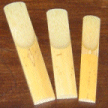
This is a question that is frequently asked by all beginning students. Its a really good
question because if students get the wrong reed size, they may become discouraged
because of the difficulty to make a sound out of the instrument. The ideal size to start
out on is a size 2. The reason to use that size is that a size 2 is a soft reed and it allows
for easy blowing. It is also easy to train your embouchure on a soft reed than a hard
reed. If you are a beginner, you want to be able to have controlled pitches when you
question because if students get the wrong reed size, they may become discouraged
because of the difficulty to make a sound out of the instrument. The ideal size to start
out on is a size 2. The reason to use that size is that a size 2 is a soft reed and it allows
for easy blowing. It is also easy to train your embouchure on a soft reed than a hard
reed. If you are a beginner, you want to be able to have controlled pitches when you
blow, enough air to last you four to eight bars of music, and a clean tone without a "fu-fu (air)" type sound.
For intermediate and advanced students, you want the reed to produce a nice, full sound. You also don't
want to work harder than you should to play the instrument; you should play your instrument with comfort
and ease. In addition, you want to take the right steps in finding the reed that will give you the sound that
you are looking for.
For intermediate and advanced students, you want the reed to produce a nice, full sound. You also don't
want to work harder than you should to play the instrument; you should play your instrument with comfort
and ease. In addition, you want to take the right steps in finding the reed that will give you the sound that
you are looking for.
Now, there is a little myth out there about reed selection for reed instruments. "The longer you have
played, the stronger the size reed you should use." Wrong! As I write this article, I have been playing for
13 years and guess what size reed I use on my tenor sax....I use a size 2 reed. If the statement above
played, the stronger the size reed you should use." Wrong! As I write this article, I have been playing for
13 years and guess what size reed I use on my tenor sax....I use a size 2 reed. If the statement above
were to be true, then I should be using a 4 or 5 reed. If
that were the case, then I wouldn't have the sound that
I have today and I would also be having a difficult time
blowing into the saxophone. The reed size you use isn't
based on how long you have been playing or your
technical abilities, it is actually based on the tip opening
of your mouthpiece. If you place the reed on the table
of the mouthpiece and place the ligature over the reed,
you should get a side view of the mouthpiece to see the
opening of the mouthpiece. The wider the opening, the
that were the case, then I wouldn't have the sound that
I have today and I would also be having a difficult time
blowing into the saxophone. The reed size you use isn't
based on how long you have been playing or your
technical abilities, it is actually based on the tip opening
of your mouthpiece. If you place the reed on the table
of the mouthpiece and place the ligature over the reed,
you should get a side view of the mouthpiece to see the
opening of the mouthpiece. The wider the opening, the
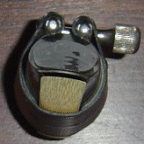
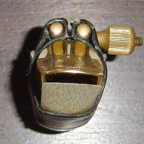
| Front view of mouthpiece- small tip opening vs. wide tip opening |
smaller the reed size you want to use. The smaller the opening, the stronger the reed size you want to
use. Finding the right reed size will help your sound, breathing, and endurance.
use. Finding the right reed size will help your sound, breathing, and endurance.
There is another factor that plays into reed selection and this information is for reed instrumentalists
that travel. The higher elevation that you travel, the softer the reed you want to use. I learned this the
hard way a few years ago when I had a performance in Lake Tahoe, Nevada. I began my warm up
that travel. The higher elevation that you travel, the softer the reed you want to use. I learned this the
hard way a few years ago when I had a performance in Lake Tahoe, Nevada. I began my warm up
routine before our sound check and I was having a difficult time blowing into
my instrument. I tried all of the reeds that I took with me on the trip (which
were size 2) and I had the same result with each reed that I used. I then saw
that the Bari sax player warming up on several different reeds. I asked him if
he had the same problem with the reeds and he then told me that the high
altitude affects the reeds. If you use a size 2, in high altitude it equals a size
2 1/2 or 3 reed. Unfortunately, I didn't have a softer reed with me in Tahoe,
so I really had to work on my reeds to prepare them for the performance
that evening. The moral of this story is: if you go to play in higher
elevations, take several reeds that are 1/2 to 1 size softer than the ones
that you usually use.
my instrument. I tried all of the reeds that I took with me on the trip (which
were size 2) and I had the same result with each reed that I used. I then saw
that the Bari sax player warming up on several different reeds. I asked him if
he had the same problem with the reeds and he then told me that the high
altitude affects the reeds. If you use a size 2, in high altitude it equals a size
2 1/2 or 3 reed. Unfortunately, I didn't have a softer reed with me in Tahoe,
so I really had to work on my reeds to prepare them for the performance
that evening. The moral of this story is: if you go to play in higher
elevations, take several reeds that are 1/2 to 1 size softer than the ones
that you usually use.

| High altitude locations like Lake Tahoe, NV has an effect on reeds |
Finding the right reed for you isn't as hard as finding the right mouthpiece. There are several different
brands and cuts out there on the market and you can get a different sound from each brand. Your
main goal should be to find the reed that is easy to play on and works well with your mouthpiece (which
should give you a rich, full sound). Now the topic of mouthpieces....well, I'll save that topic for another
day.
-10/15/04
brands and cuts out there on the market and you can get a different sound from each brand. Your
main goal should be to find the reed that is easy to play on and works well with your mouthpiece (which
should give you a rich, full sound). Now the topic of mouthpieces....well, I'll save that topic for another
day.
-10/15/04